What 11, 12, 21 and 22 Personnel Mean, and How Often NFL Teams Use Each
The first digit is running backs, the second is tight ends. NFL offenses used 11 personnel on 57% of snaps through Week 1; the Giants used it on 34%, 30th in the league.
In a personnel grouping, the first digit is the number of running backs on the field and the second is the number of tight ends. An offense in 11 personnel has one back and one tight end. An offense in 22 personnel has two backs and two tight ends.
The number of wide receivers is never stated because it does not have to be. An offense puts 11 players on the field, and on almost every snap five of them are offensive linemen and one is the quarterback. That leaves five spots. Subtract the backs and the tight ends and the rest are receivers. So 11 personnel has three receivers, 12 personnel has two, and 22 personnel has one.
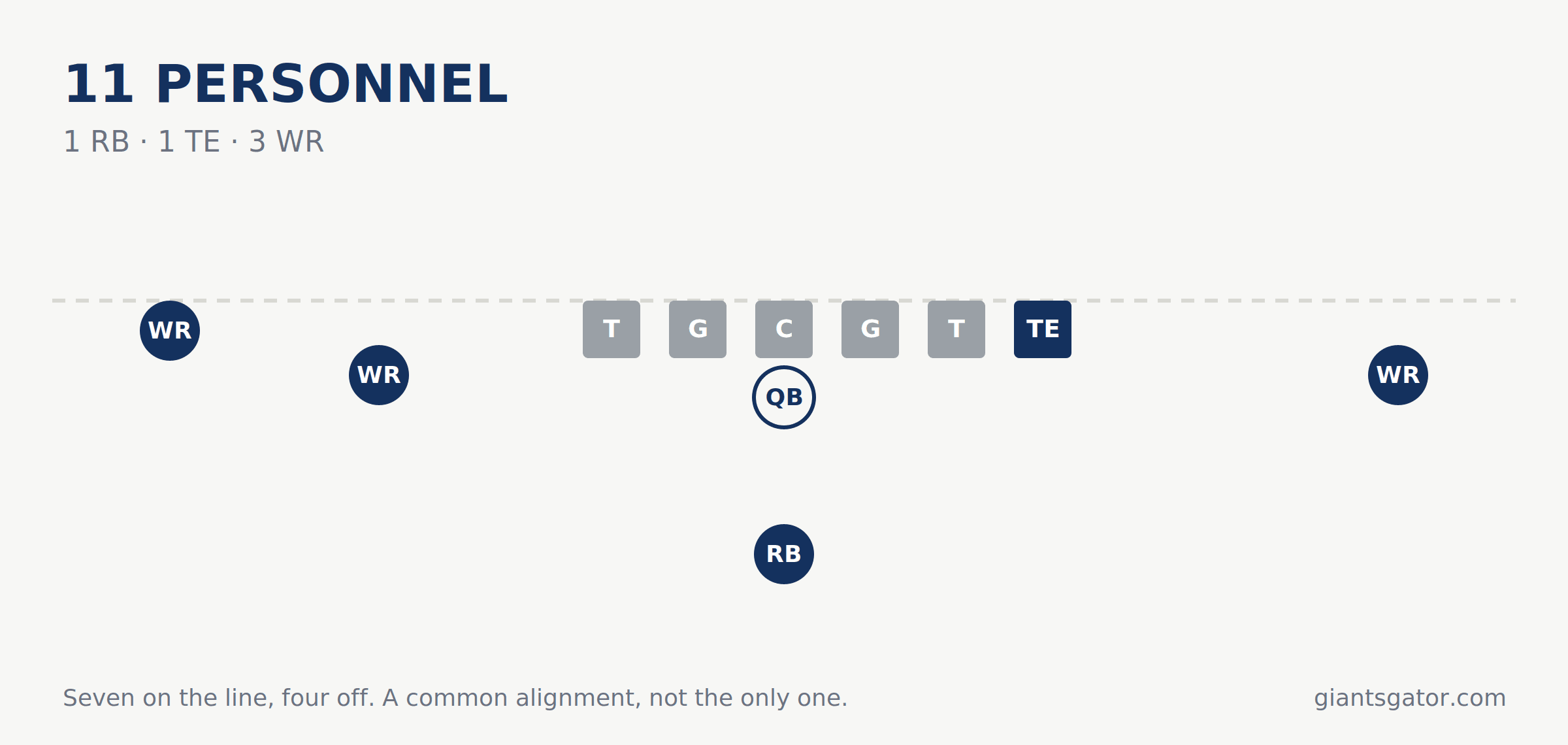
What is 11 personnel?
One running back, one tight end, three wide receivers. It is the most common grouping in the NFL. Through Week 1 of the 2026 season, teams ran it on 57% of their offensive snaps, according to Sharp Football Analysis.
What is 12 personnel?
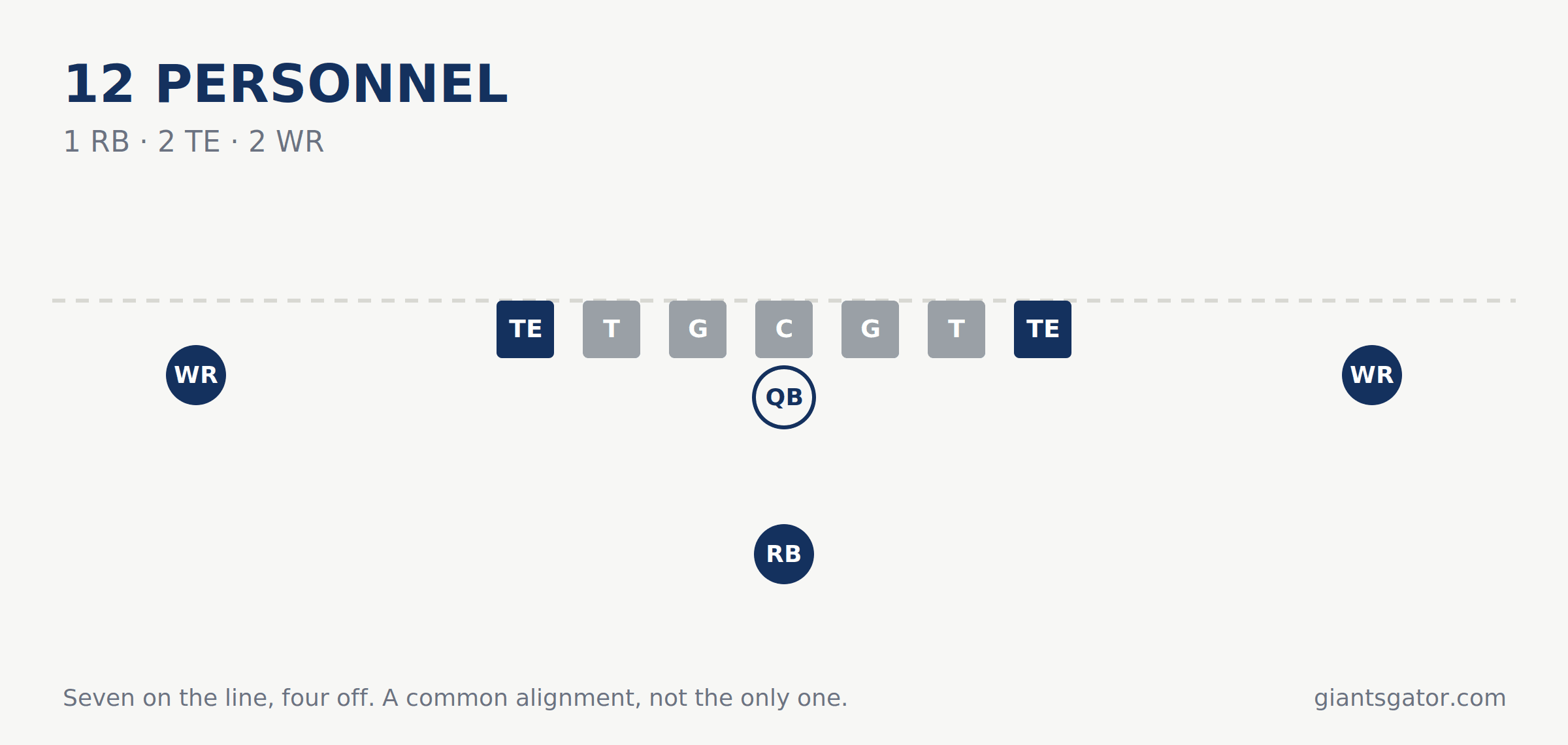
One running back, two tight ends, two wide receivers. League usage through Week 1 was 22%. It is the standard way to add a blocker without dropping all the way to a single receiver. Sharp's charting puts league-wide use of two or more tight ends at 28% in 2021 and 33% in 2025.
What is 21 personnel?
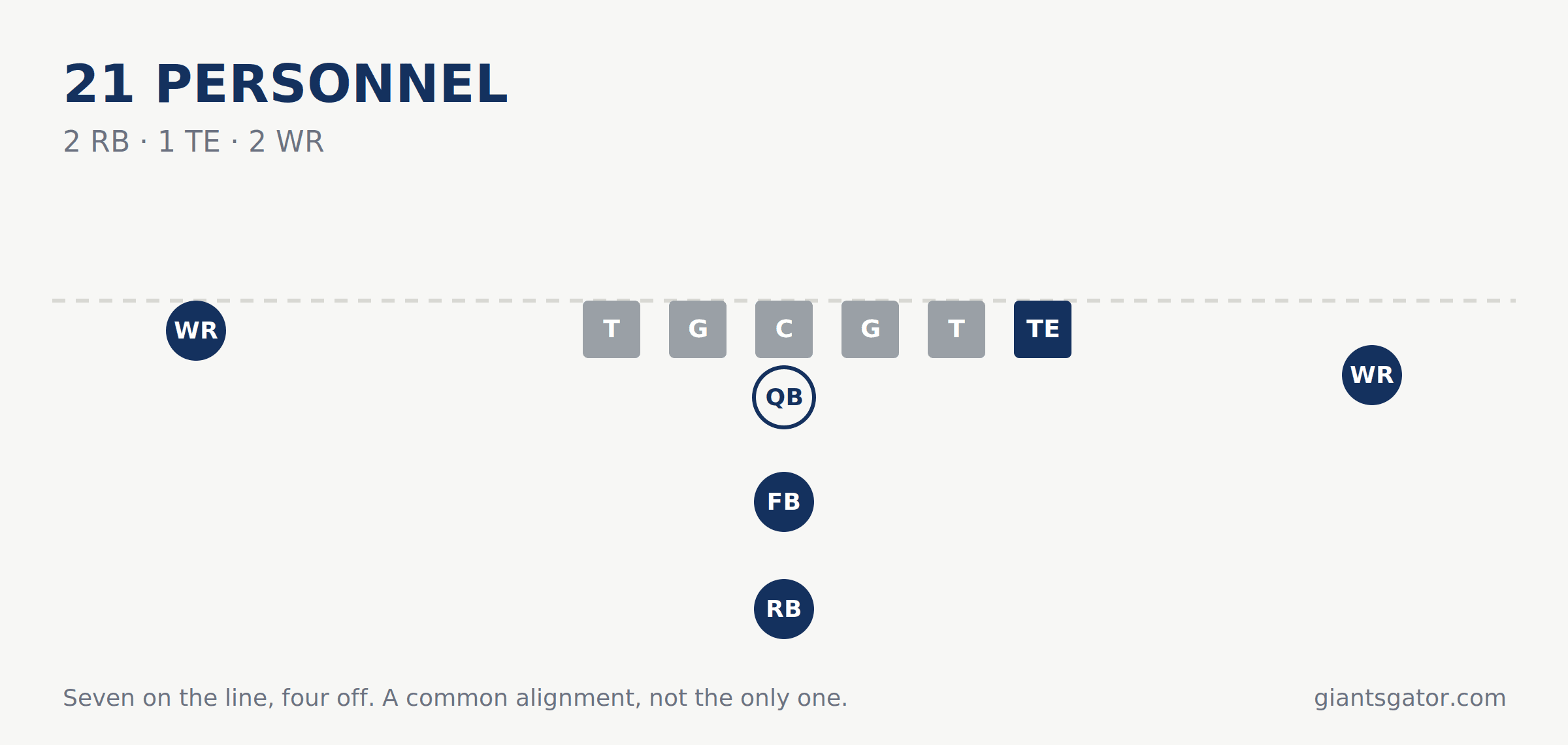
Two running backs, one tight end, two wide receivers. League usage through Week 1 was 8%. By the usual convention a fullback counts as a running back, so an offense with a halfback and a fullback on the field is in 21 personnel.
What is 22 personnel?
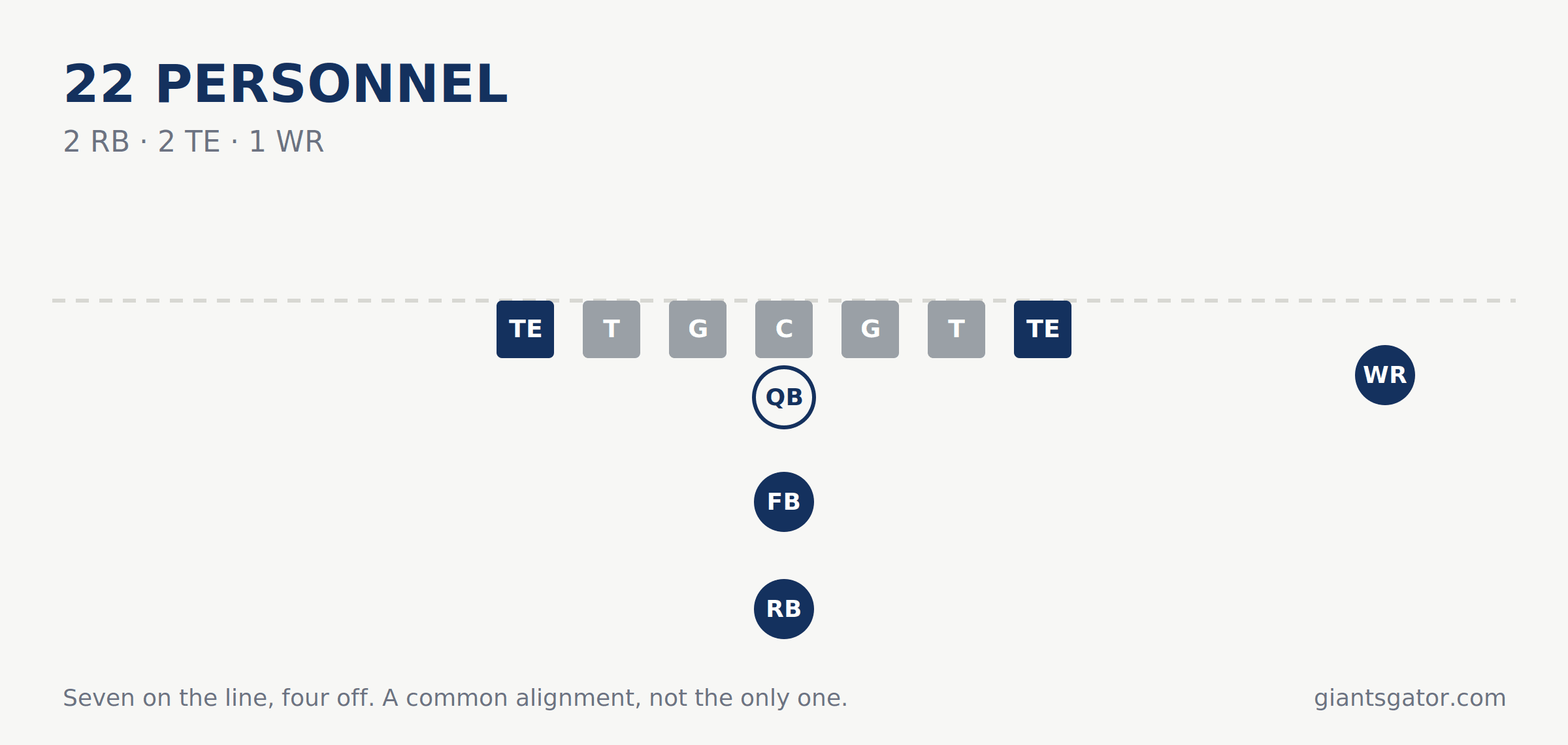
Two running backs, two tight ends, one wide receiver. League usage through Week 1 was 3%, the least-used of the five groupings Sharp breaks out.
What about 10, 13 and 20 personnel?
The same rule applies. An offense in 10 personnel has one back, no tight end and four receivers. In 13 personnel it has one back and three tight ends. In 20 personnel it has two backs, no tight end and three receivers. Sharp charts 13 personnel at 8% league-wide through Week 1. It breaks out only 11, 12, 13, 21 and 22, so 10 and 20 personnel do not appear as their own columns.
The full set of groupings, with league usage through Week 1:
| Grouping | On the field | Wide receivers | League usage, Week 1 |
|---|---|---|---|
| 10 | 1 RB, 0 TE | 4 | Not broken out |
| 11 | 1 RB, 1 TE | 3 | 57% |
| 12 | 1 RB, 2 TE | 2 | 22% |
| 13 | 1 RB, 3 TE | 1 | 8% |
| 20 | 2 RB, 0 TE | 3 | Not broken out |
| 21 | 2 RB, 1 TE | 2 | 8% |
| 22 | 2 RB, 2 TE | 1 | 3% |
Why some receivers line up off the line
Where those players stand is constrained by rule. Seven offensive players must be on the line of scrimmage at the snap, which leaves four off it, and the quarterback is one of the four. Only the two players at the ends of the line and the four off it may catch a forward pass.
That is why a three-receiver set never has all three receivers on the line. A receiver who lines up on the line outside a tight end becomes the end man, and the tight end, now the inside man, cannot catch a pass on that play. Coaches call it covering him up. Getting the count wrong is an illegal formation penalty, five yards.
How often NFL teams use each grouping
Through Week 1 of 2026, Tampa Bay ran 11 personnel on 84% of its snaps and San Francisco ran it on 28%. Buffalo used three tight ends on 39% of its snaps and Los Angeles on 38%. Baltimore ran 12 personnel on 45%.
The two-back groupings are where teams diverge most sharply in kind. San Francisco and Las Vegas each put two backs on the field for 52% of their snaps. Twenty teams show no 22-personnel snaps at all.
How the Giants use personnel
The Giants were the league's third-heaviest two-back offense in Week 1, at 51%, and 30th of 32 in 11 personnel at 34%. They ran 21 and 22 personnel 13 times each, 20% apiece, against league averages of 8% and 3%. Sharp's two-back figure is broader than 21 and 22 personnel combined and includes two-back snaps in other groupings.
Fullback Patrick Ricard played more than half of the Giants' offensive snaps against Dallas. GiantsGator covered the full breakdown in its analysis of the Giants' Week 1 personnel rates.
Sharp's table has the Giants using two backs on 1.1% of their snaps last season, 12 plays out of 1,074.
Why personnel matters
Defenses substitute in response to what the offense sends out. Extra tight ends and backs usually draw linebackers and safeties onto the field; three and four receivers usually draw an extra cornerback. An offense that can run and throw from the same grouping forces the defense to defend both with one set of players.
A team that uses 11 personnel on most snaps forces the defense to pick a package before the offense shows what it intends to run. A team that uses 21 and 22 personnel shows its intent first and makes the defense answer it.
How the numbers are counted
Sharp Football Analysis charts personnel on every play and excludes kneel-downs, spikes and plays where the personnel data is incomplete. Its efficiency figures — expected points added, yards per play and success rate — require at least 20 plays in a grouping before they display. Usage percentages carry no such threshold, which is why a one-week sample can show a rate without showing whether it worked.
The Giants play at the Rams on Monday, Sept. 21.